Car battery services in the UAE are likely to become more mobile, data-driven and preventive by 2030. Instead of waiting for a battery to fail and then visiting a workshop, drivers could increasingly receive battery-health warnings, book roadside replacement digitally, track technicians in real time and get a battery tested before deciding whether replacement is actually necessary.
The shift will not happen overnight. Conventional petrol and diesel vehicles will remain on UAE roads alongside hybrids and EVs, meaning service providers may need to support several battery technologies at the same time. One factor is unlikely to disappear: heat. High temperatures accelerate conventional battery degradation, making battery testing and preventive maintenance particularly relevant in the UAE climate.
1. Mobile Battery Replacement Could Become the Normal Service Model
Traditional battery replacement usually involves taking the vehicle to a garage, waiting for testing and then having a replacement installed. Mobile services reverse that process by taking the technician, diagnostic equipment and suitable battery directly to the vehicle.
By 2030, Mobile Car Battery Replacement in Dubai could become even more location-based. A driver may enter the vehicle registration details, share a location, receive compatible battery options and see an estimated technician arrival time before confirming the booking.
For someone searching for a car battery in dubai, the decision may therefore depend less on finding the nearest physical battery shop and more on comparing availability, warranty, compatibility, testing results and arrival time through a digital platform.
2. Faster Diagnostics May Reduce Unnecessary Battery Replacements in Dubai
A no-start problem does not always mean the battery itself needs replacing. Problems with alternators, starter motors, charging systems, terminals or excessive electrical drain can produce similar symptoms.
Portable diagnostic equipment is likely to become more important as mobile services expand. Technicians could test battery voltage, starting performance and charging-system behaviour at the roadside before recommending a replacement.
This may make a future car battery change in dubai faster without turning it into an automatic battery swap. Better diagnosis could help determine whether the driver actually needs a new battery or another electrical repair.
3. Connected Vehicles Could Predict Battery Problems Earlier
Connected cars already generate large amounts of information about vehicle condition. As onboard monitoring becomes more sophisticated, battery-health information could increasingly become part of that data.
Instead of discovering a weak battery when the engine fails to start, a vehicle might identify deteriorating voltage or abnormal charging behaviour and alert the driver through the dashboard or an app.
This could gradually move the industry from emergency replacement toward predictive maintenance. Fleet operators could benefit particularly because batteries could be inspected during scheduled downtime rather than after vehicles become stranded.
4. Roadside Battery Assistance in Dubai Could Become Faster
Emergency response is also likely to become more digitally coordinated. A future of jump start service in dubai request could automatically share the stranded vehicle’s location, model and battery specification with a nearby technician, reducing the information that has to be exchanged by phone.
Dispatch systems may also assign jobs according to technician location, battery inventory and traffic conditions. Drivers could receive live arrival updates similar to those already common in delivery and ride-booking apps.
The practical objective would remain simple: determine whether the battery needs a temporary jump start, charging, further diagnosis or replacement.
5. EV and Hybrid Growth Will Change the Meaning of Battery Service
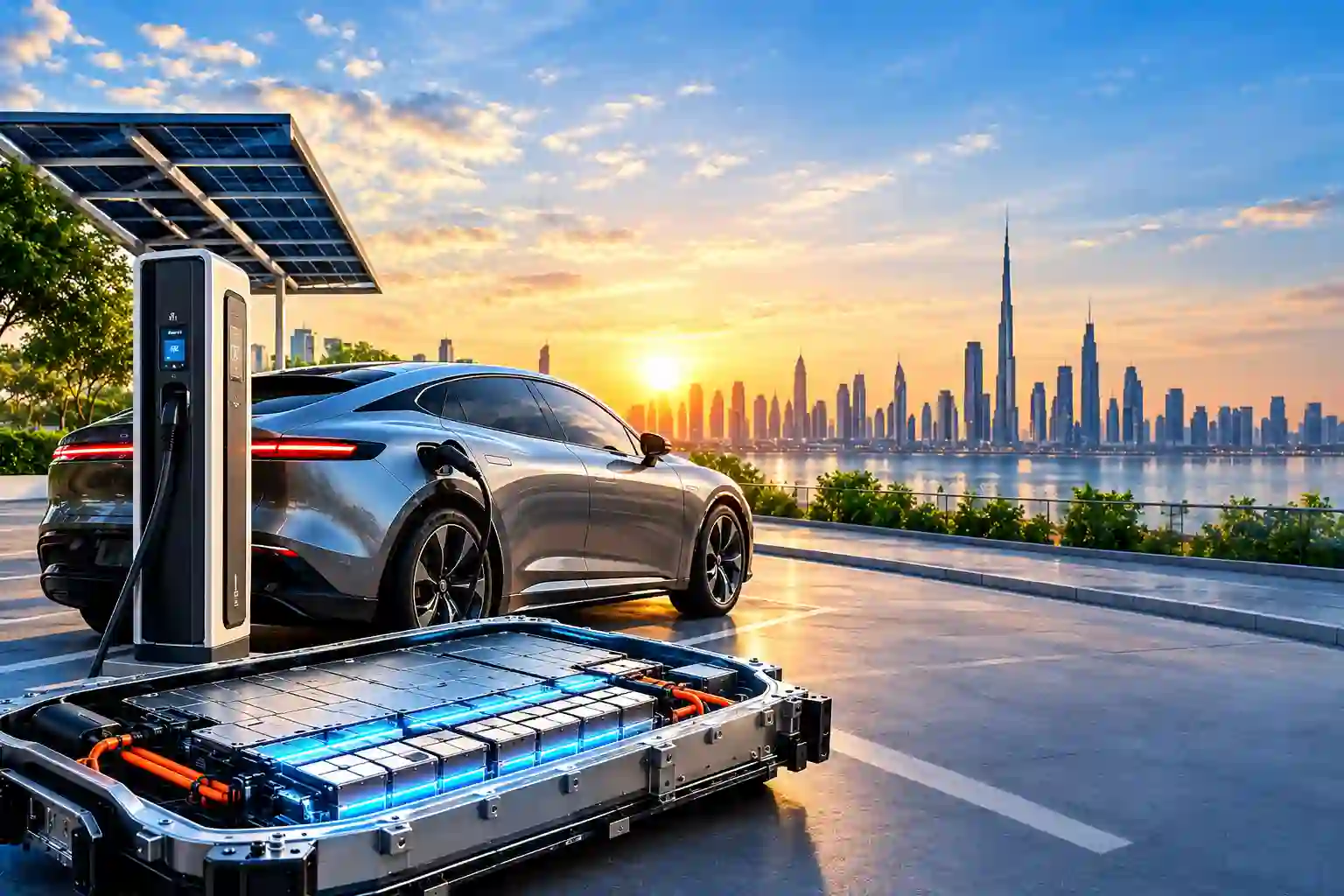
The UAE is actively developing its electric-mobility ecosystem. Dubai’s EV charging network had expanded to around 1,860 charging points by early 2026, while national policy supports the continued development of charging infrastructure and greater use of electric transport.
This does not mean conventional battery services will suddenly disappear. Many hybrids and electric vehicles still use a separate low-voltage battery for control systems, locks, lighting and vehicle electronics.
The transition described in UAE Car Battery Market 2026: Growth Forecast, Replacement Demand, and Industry Transformation therefore provides an important bridge between today’s replacement market and what may emerge by 2030. Service providers could eventually need expertise covering conventional lead-acid batteries, AGM systems, hybrid auxiliary batteries and increasingly complex EV electrical systems.
6. Battery Technology May Improve, but UAE Heat Will Still Matter
Battery manufacturers will continue working on improvements in durability, charging efficiency, thermal management and monitoring. Better materials and vehicle energy-management systems could help some batteries last longer.
However, UAE operating conditions remain demanding. Heat accelerates chemical reactions and degradation in conventional automotive batteries, so improved technology will not eliminate the value of testing and preventive maintenance.
Drivers may therefore begin paying more attention to battery-health measurements rather than relying only on battery age.
7. Sustainability and Battery Recycling Could Become More Important
More battery replacements also create a responsibility to handle old batteries correctly. Used automotive batteries contain materials that can be recovered and recycled, while improper disposal can create environmental risks.
By 2030, battery providers and workshops may face stronger expectations around collection, documented recycling and responsible disposal. Digital service records could also make it easier to record when an old battery was collected after a replacement.
Sustainability could consequently become part of everyday service operations rather than something handled separately.
8. Traditional Workshops Will Need to Adapt
Physical workshops are unlikely to disappear. Complex electrical faults, charging-system repairs and high-voltage EV work will continue to require specialist equipment and controlled working environments.
What may change is the workshop’s role. Some businesses could combine workshop facilities with mobile vans, digital bookings, remote customer support and connected diagnostic services.
The strongest model may therefore be a hybrid one: simple testing, jump starts and replacements handled at the customer’s location, with more complex faults directed to a properly equipped workshop.
What Could UAE Drivers Expect by 2030?
By 2030, getting help with a weak vehicle battery may require fewer phone calls and less guesswork. Drivers could receive earlier warnings, obtain battery-health information, book through an app, track a technician and get the correct battery delivered to their location.
For service providers, the bigger challenge will be technical. They may need to understand a broader range of vehicles, use better diagnostics, manage mobile inventories and develop expertise in both traditional and electrified vehicles.
The future of UAE battery service is therefore likely to be less about simply selling replacement batteries and more about accurate diagnosis, convenient response, vehicle data, responsible recycling and preventing breakdowns before they happen.
FAQs
Will car battery replacement become completely mobile by 2030?
Probably not. Mobile replacement could become more common for straightforward battery problems, while workshops will remain necessary for complex electrical faults and specialised EV work.
Will electric vehicles eliminate the need for 12V battery services?
Not necessarily. Many EVs and hybrids use a low-voltage auxiliary battery alongside their main traction battery, although battery designs may continue changing.
Can smart vehicles predict battery failure?
Increasingly detailed battery monitoring could identify declining performance before complete failure, although prediction accuracy will depend on the vehicle and battery-management system.
Why will battery diagnostics remain important in the UAE?
High temperatures can accelerate conventional battery degradation. Testing helps determine battery condition and can also identify charging-system problems before unnecessary replacement.
Will traditional battery workshops disappear?
They are more likely to adapt than disappear. Workshops may increasingly combine physical repair facilities with mobile servicing, online bookings and advanced electrical diagnostics.